
The short answer
Yes, AI can lie to you.
Not on purpose. An AI model has no motive. But it can invent a fact, a quote or a court case, present it in a confident tone, and leave you no hint that anything is wrong. For the person relying on the answer, that is a lie.
Hallucination is the main cause. A smaller share comes from selective framing, safety-shaped answers and personalization: an assistant with memory may shape its answer around what it knows about you. The fix is the same in every case: don't let one answer from one model be the final word.
What it is
A fluent, confident answer that is false. Full definition in the AI glossary.
Why it happens
Models predict likely words, and guessing tends to be rewarded.
How to catch it
Cross-check models and open every source.
Real AI hallucinations with real consequences
These are documented cases, not hypotheticals. In each one, the AI's answer looked professional and turned out to be wrong.
Mata v. Avianca: invented court cases
Lawyers in a New York personal-injury case filed a brief citing cases that ChatGPT had made up. A federal judge sanctioned them and fined them $5,000.
Lesson: a citation that looks right is not proof it exists.
Google Bard's telescope error
A promotional demo had Bard say the James Webb Space Telescope took the first picture of a planet outside our solar system. That image was taken in 2004 by another telescope. Alphabet shares fell 7.7% that day.
Lesson: even a vendor's own showcase answer can be wrong.
Air Canada's chatbot policy
The airline's website chatbot told a grieving customer he could claim a bereavement discount after travel. The real policy said otherwise. A tribunal rejected Air Canada's argument that the chatbot was responsible for itself and ordered it to pay.
Lesson: check AI answers against the official policy page.
Why does AI hallucinate?
The short version: a language model is a very good predictor of what text should come next. It is not a database. When it doesn't know something, it often produces the most plausible-sounding answer instead of stopping.
It predicts, it doesn't look up. Unless the model is connected to search or your files, it answers from patterns learned in training, and patterns can be wrong.
Rare facts have no pattern. Grammar and common knowledge repeat across millions of documents. A specific person's birthday or a niche court ruling may not, so the model fills the gap.
Guessing gets rewarded. OpenAI researchers argued in 2025 that common training and benchmark scoring give credit for lucky guesses and nothing for "I don't know", which nudges models toward confident answers (OpenAI).
Training data goes stale. Prices, laws, product names and people change after a model's training cut-off.
Your prompt can push it. A leading question ("Which study proves…?") or a request for sources the model doesn't have invites it to invent them.
Hallucination isn't the only way AI misleads
Most false answers are hallucinations. A few other mechanisms produce answers that are technically defensible but still leave you with the wrong picture.
Test prompt for memory
“Answer this as if you have no memory of me. Then answer again using what you know about me. Show exactly what changed.”
How to catch an AI hallucination
"Are you sure?" isn't enough. A model can be confidently wrong twice. Test the answer from outside the conversation.
Cross-check independent models
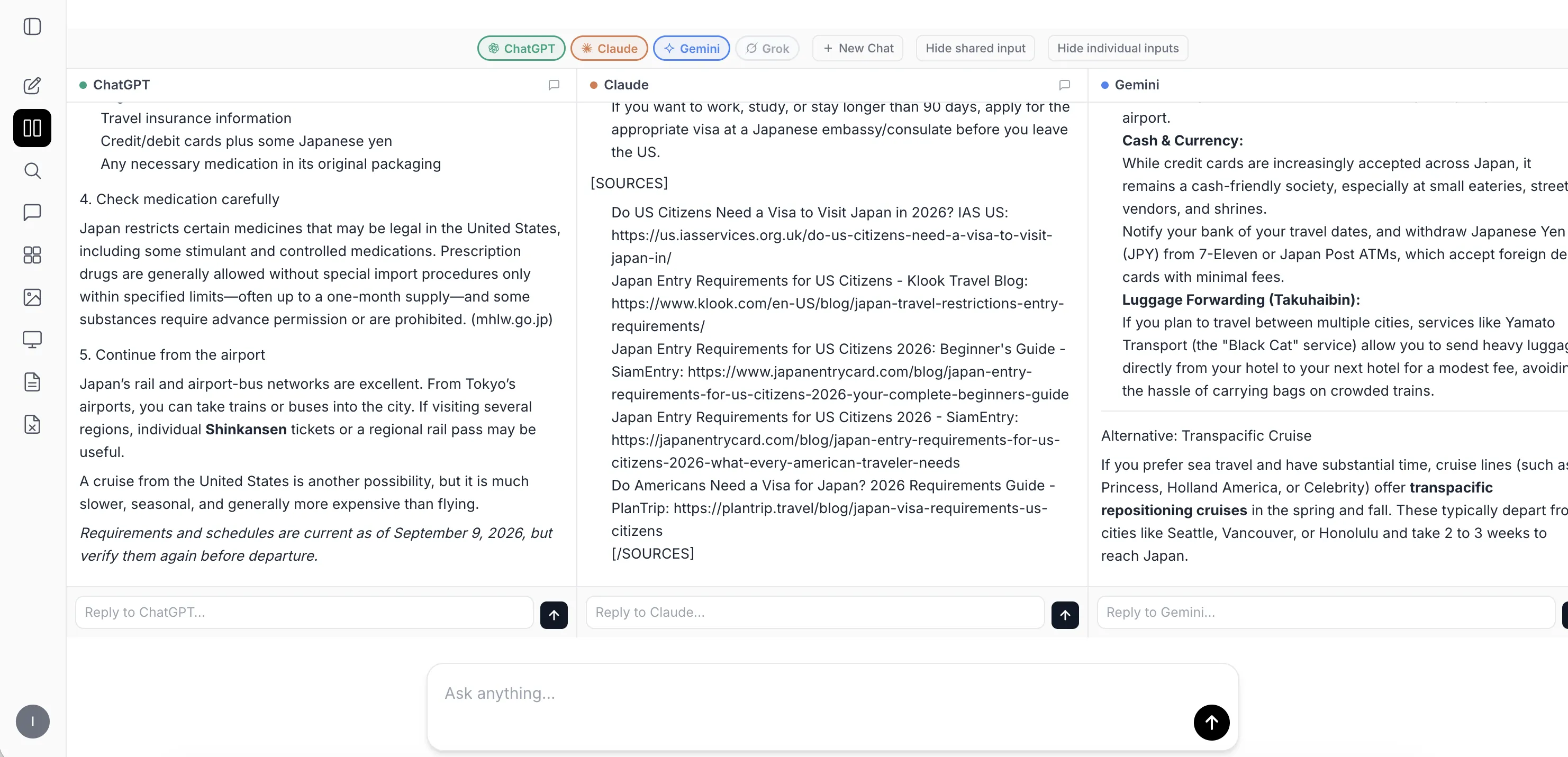
Send the same question to several models. Agreement isn't proof, but disagreement shows exactly which claim to check. MultipleChat can do this automatically with Auto Verification.
Open every source
Click the link, find the quote, read the case. If a source can't be found, treat the claim as unverified.
Ask again in a clean context
Use a fresh chat with memory off. If the answer changes materially, personalization was shaping it. See how to use AI without memory.
Escalate high-stakes questions
For law, medicine, money, safety or employment, use AI as a starting point and confirm with an authoritative source or a qualified professional.
Use MultipleChat Compare Mode
Get up to 4 AI answers side by side, without a memory-shaped relationship.
Compare Mode sends the same question to multiple AI models at once and shows the answers side by side. It does not save your preferences into a memory profile that shapes future answers.
Bottom line
AI can lie. Treat one answer as a draft, not a fact.
AI hallucinations are a known property of today's models, not a rare glitch. When the answer matters, compare models, open the sources, and ask without memory before you act.
FAQ
Try the safer workflow
Don't let one AI define reality for you.
Use MultipleChat Compare Mode to get up to 4 answers from different AI models side by side, and spot hallucinations where they disagree.
Activate Compare Mode